Photo by @cosyneefoto
김
예
지
Material Memory: A Return to Making
Yeji Kim is a Seoul-based artist who works with natural luffa, a material she came to indirectly.
Trained in woodworking, she later worked as an interior designer, where her practice gradually shifted toward digital methods. As that distance from making grew, so did the need to return to it. A workshop at Boisbuchet marked the turning point, bringing her back to material thinking.
Back in Seoul, she began working with everyday objects — eventually leading her to luffa.
Forms Follow Process
As she had no prior knowledge or preconceptions about luffa, it allowed her to see it not in terms of its conventional use, but simply as a material.
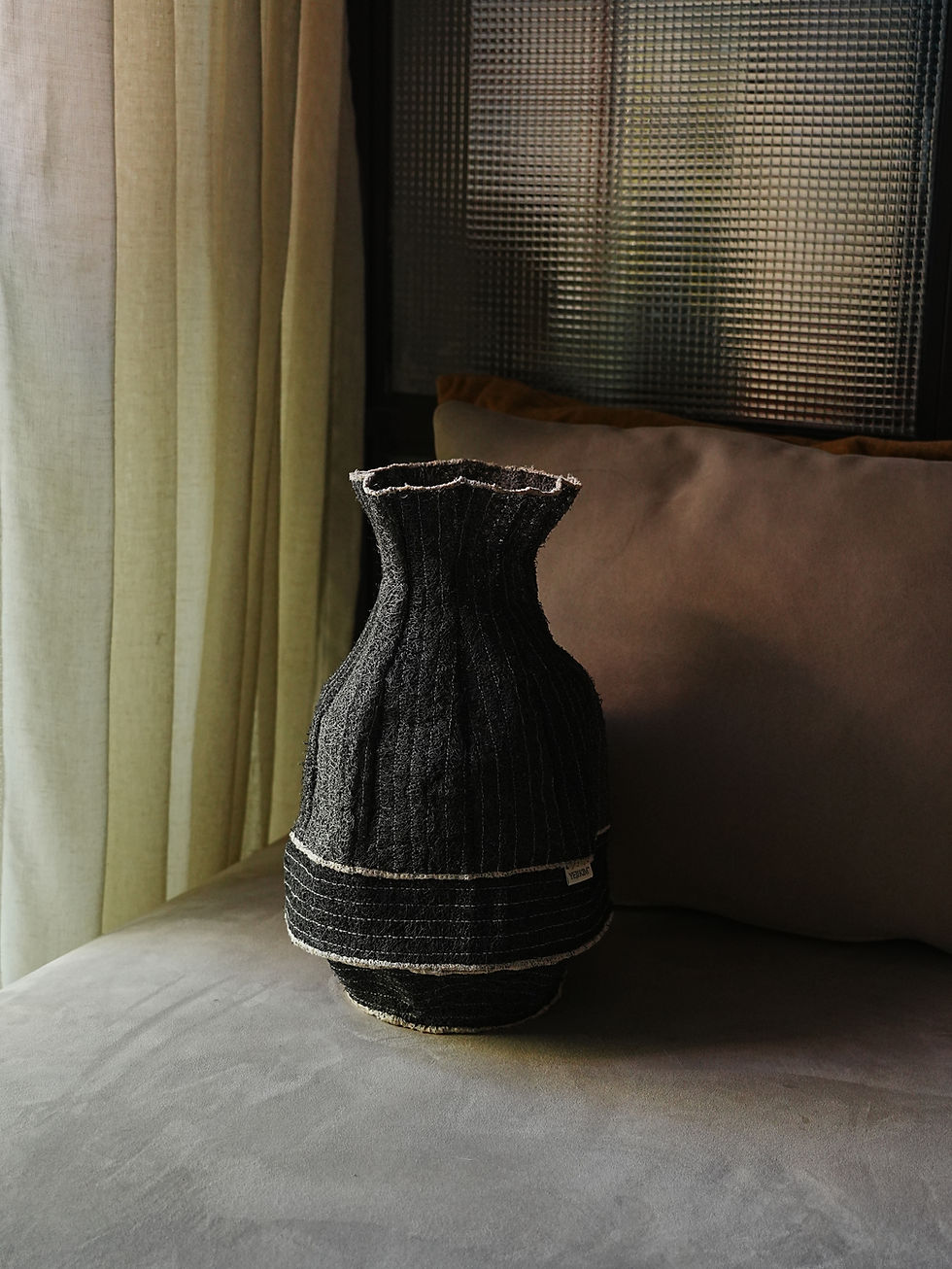
She was drawn to its porous texture, lightness, and its quality as a natural material so she began experimenting — cutting, pressing, deconstructing it, and eventually putting it through a sewing machine.

Courtesy of ADERERROR
"I noticed that its loose structure could still be maintained. That was the moment I realised it could be treated like a fabric."
From that point, everything followed.
Her process is guided by the material itself — its porosity, lightness, the way its texture shifts under different conditions.
Form is never decided in advance. The Check Basket developed from earlier flat explorations into a three-dimensional form, Through which she discovered the sculptural potential of luffa and its capacity for a wider range of patterns and structures.
Each piece is arrived at, not planned.
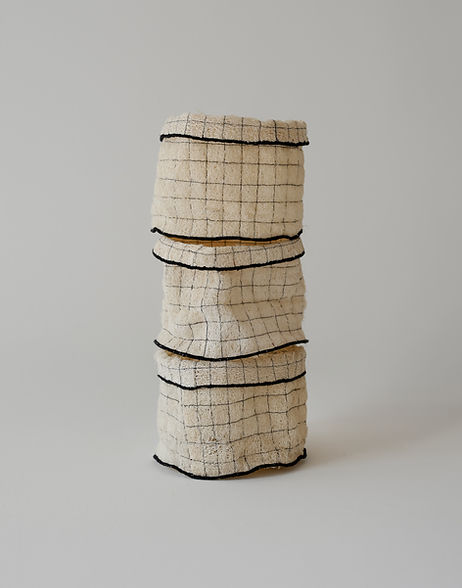
Photo by @cosyneefoto

Photo by @cosyneefoto

Photo by @cosyneefoto

"The making process itself provides clues for the next step. The challenges that arise along the way often lead the work in a better direction."
Photo by @cosyneefoto
Functional Longevity
While others working with natural materials lean into impermanence, Yeji takes a different position. Instead, she explores how luffa can exist longer within everyday life—developing forms that are both durable and functional, balancing form and function while preserving the inherent qualities of luffa, allowing each piece to exist as both sculptural object and functional piece.
Her current works are the beginning of a much larger vision. When asked what she would make without constraints, she describes an imagined house built entirely from luffa —
"from flooring to wall panels, the entire space is constructed with luffa-based materials, forming a complete environment" — combined with dye, wood, and metal to achieve the finish of refined interior materials, merging her current and past practice.

Courtesy of NR Ceramics

Courtesy of NR Ceramics
Her practice found a natural home at Still: objects that are crafted with skill and meant to be lived with.