
Still in good company
- A growing artisan collective -
Meet the artists/ makers/ creators who shape Still, one practice at a time.


Photo by @cosyneefoto
김
예
지
Material Memory: A Return to Making
Yeji Kim is a Seoul-based artist who works with natural luffa, a material she came to indirectly.
Trained in woodworking, she later worked as an interior designer, where her practice gradually shifted toward digital methods. As that distance from making grew, so did the need to return to it. A workshop at Boisbuchet marked the turning point, bringing her back to material thinking.
Back in Seoul, she began working with everyday objects — eventually leading her to luffa.
Forms Follow Process
As she had no prior knowledge or preconceptions about luffa, it allowed her to see it not in terms of its conventional use, but simply as a material.
She was drawn to its porous texture, lightness, and its quality as a natural material so she began experimenting — cutting, pressing, deconstructing it, and eventually putting it through a sewing machine.

Courtesy of ADERERROR
"I noticed that its loose structure could still be maintained. That was the moment I realised it could be treated like a fabric."
From that point, everything followed.
Her process is guided by the material itself — its porosity, lightness, the way its texture shifts under different conditions.
Form is never decided in advance. The Check Basket developed from earlier flat explorations into a three-dimensional form, Through which she discovered the sculptural potential of luffa and its capacity for a wider range of patterns and structures.
Each piece is arrived at, not planned.
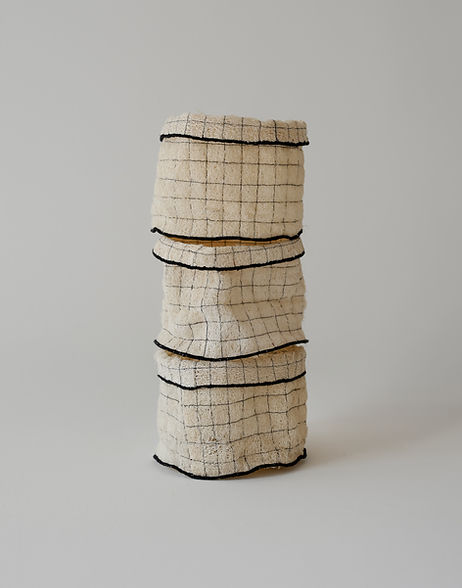
Photo by @cosyneefoto

Photo by @cosyneefoto

Photo by @cosyneefoto

"The making process itself provides clues for the next step. The challenges that arise along the way often lead the work in a better direction."
Photo by @cosyneefoto
Functional Longevity
While others working with natural materials lean into impermanence, Yeji takes a different position. Instead, she explores how luffa can exist longer within everyday life, developing forms that are both durable and functional, balancing form and function while preserving the inherent qualities of luffa, allowing each piece to exist as both sculptural object and functional piece.
Her current works are the beginning of a much larger vision. When asked what she would make without constraints, she describes an imagined house built entirely from luffa —
"From flooring to wall panels, the entire space is constructed with luffa-based materials, forming a complete environment". Combined with dye, wood, and metal to achieve the finish of refined interior materials, merging her current and past practice.

Courtesy of NR Ceramics

Courtesy of NR Ceramics
Her practice found a natural home at Still:
objects that are crafted with skill and meant to be lived with.


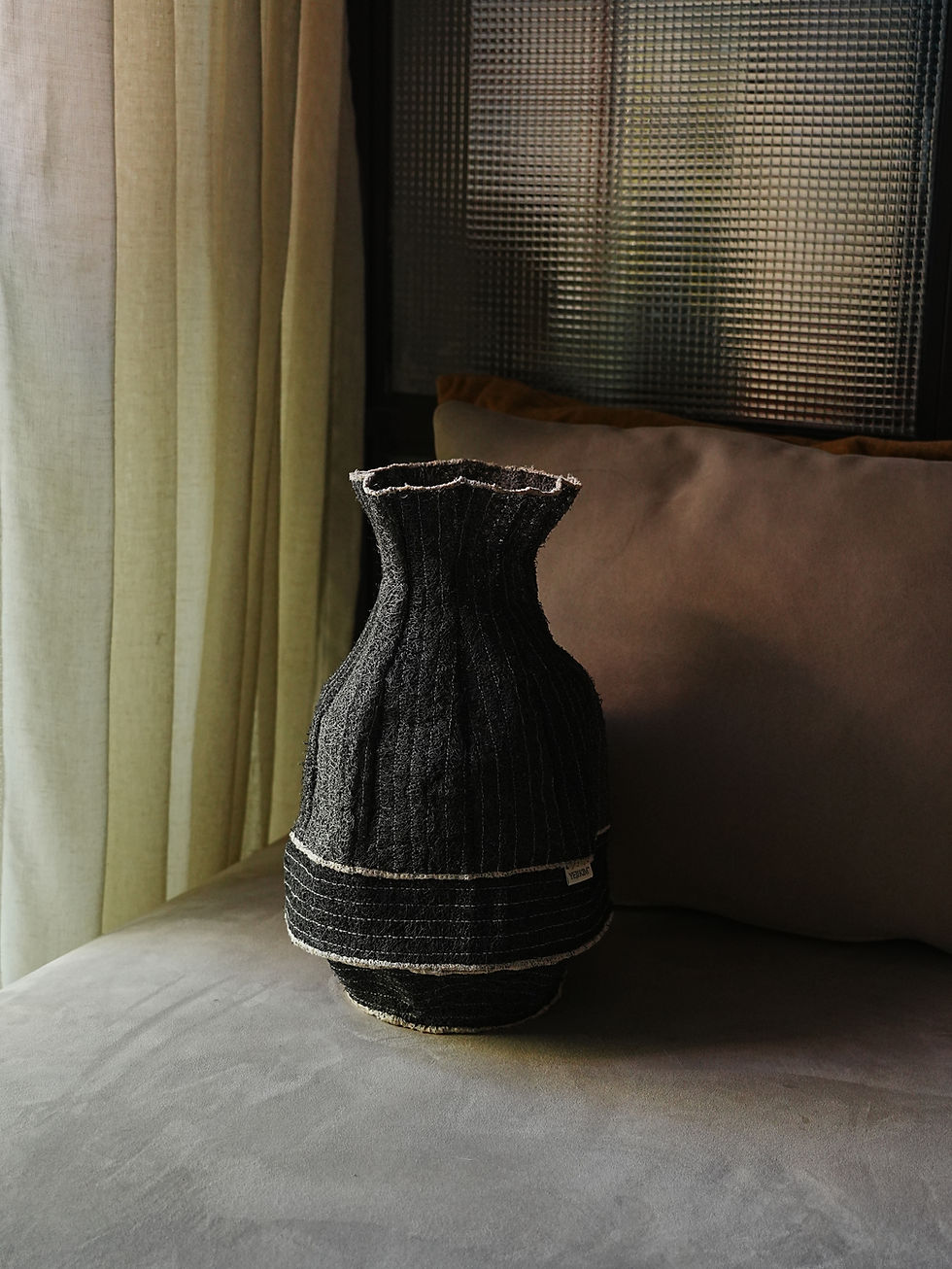


Photo by @cosyneefoto


Photographer: ____rova_ / Photo courtesy of Yu Hyeon
유현
From Passing Feeling to Lasting Form:
The Sculptural Language of Yu Hyeon
Yu Hyeon approaches sculpture as a way of holding onto life’s fleeting moments. Joy, doubt, loneliness, passion. The emotions one encounters become the material of his work. Through sculpture, he visualises and records these experiences, revealing how what once seemed insignificant may, over time, carry its own lasting value
A Leap to Art
Raised in the Korean countryside, art began as a quiet hobby alongside an office job. Observing the lives of artists gradually shifted his perspective. Where many professions ask people to suppress their inner narratives, artists bring them to the surface.
This realisation led him to take a leap of faith and pursue sculpture full-time. Without formal training, but with his mother’s unwavering faith in his decision, Yu Hyeon taught himself and spent years shaping his practice through persistence and dedication.

Photographer: ____rova_ / Photo courtesy of Yu Hyeon

Milky Way: Lines and Dots
Still: " Because Milky Way can be reshaped, how do you imagine collectors interacting with the work over time?"
YH : " The key element of the Milky Way series is that every line connects at specific dots. Collectors are free to reshape the lines to suit their space or mood, but no matter how far they stretch, they always meet again at these points.
This idea reflects how I think about human relationships. Our connections can shift over time or distance, sometimes appearing scattered, but the moments we share remain as “dots” that continue to link us within the universe we live in. Through Milky Way, I wanted to speak about the quiet preciousness of these connections.
The series also came from a practical question. As a sculptor and installation artist in Korea, I often work with large wooden sculptures that are heavy and difficult to bring abroad. I started wondering how I could share my work more easily with people in different places.
Milky Way became my response. Using lightweight, flexible wire, I created a work that can travel easily and adapt to different spaces. In the same way the lines can stretch and reshape, I hope that connections between people, even across distance, can continue to hold and extend a little further. "

Photographer: ____rova_ / Photo courtesy of Yu Hyeon
Returning Home
In 2024, after years of working primarily in Seoul, Yu Hyeon returned to his hometown of Gongju to establish the Yu Hyeon Museum. The space marks both a homecoming and a new chapter in his practice, creating opportunities for artistic dialogue beyond the metropolitan centre.

Photographer: ____rova_ / Photo courtesy of Yu Hyeon

Legacy and Renewal
When reflecting on his recent work, Yu Hyeon often returns to the influence of his mother. She was the only person who supported his decision to leave a stable job and become an artist, and her belief sustained him through years of uncertainty.
After her passing, many of his works carried traces of grief and longing. Becoming a parent himself gradually shifted that perspective. Rather than remaining in sorrow, he now carries forward the legacy of her faith, allowing it to shape a renewed beginning for both his life and his art.
When asked if the Milky Way sculptures had a sound,
Yu Hyeon imagines it somewhere close to this.
Stay close on our IG to discover the rest of
Yu Hyeon’s top 5 music for the Milky Way sculptures.


Tosha Jagad
Tosha Jagad is a Mumbai-based ceramic artist who transitioned from a decade-long career in graphic design to working with clay. Her practice, shaped by a passion for hands-on material exploration and the technical nuances of ceramics, combines hand-building techniques like slab work and wheel throwing.
Drawing inspiration from everyday objects and observations gathered during her travels and daily life, she crafts small-scale sculptural works in clay. Given her background in design, her creative process often begins with two-dimensional explorations using sketches and illustrations which is then brought to life in a more tactile form with clay.

大森健司
Kenji Omori
With a background in architecture, it’s no surprise that Kenji incorporates refined and clean forms in his works.
His pieces are made from a blend of coarse black clay and finer iron-rich red clay. To preserve the original color and rustic feel of the clay, the outer surface of the vessels are left unglazed. That way, you would be able to feel the warmth and organic texture of the clay itself.


太田良子
Ryoko Ota
A glass artist based in Kyoto, Japan, who has been working with glass since the 1990s. She uses the kilnwork technique, placing glass beads in a plaster mold, fires and melts them in a furnace to form various shapes. This technique even allows her to draw lines and create different textures.
In a world where things overflow, she feels immense gratitude to those who appreciate what she creates because she holds close to her heart to only creates objects that she loves.


太田 一永
Kazunaga Ota
It all started with his fascination in leather bag making when he was in high school. He went on to pursue leather-making in Kobe, Italy and at manufacturers in Osaka.
He now crafts leather accessories in a small village in Hiroshima Prefecture, working with the leather of the wild deer and boar which have been culled due to ecosystem imbalances and damage to farmland. In Japan’s rural regions, over a million wild animals are culled annually, yet only a fraction of their hides are used.
Embracing their imperfections — scars and holes that speak to each creature’s story — he forges a deeper connection between nature and craft, honoring lives once lived by transforming discarded hides into functional works of art.
The leather is dyed with natural materials such as walnut and indigo leaves, adding another layer of richness and depth to each piece.
.jpg)
